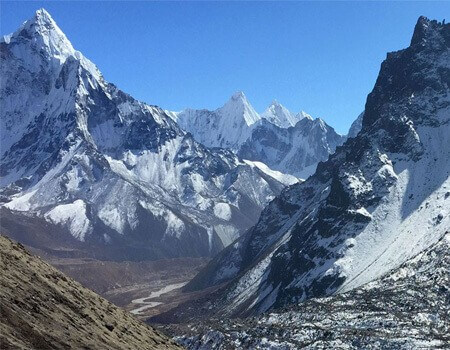
The Everest Three High Passes trail in the Everest Region is ideal for adventure and regular hikers who enjoy high-altitude trekking. It is one of the most adventurous mountain treks in the Nepalese Himalayas and suits adventure trekkers who explore the Khumbu Everest region wisely.
The Everest High Passes trail follows the regular Everest Base Camp trekking route to Dingboche village, then splits right, continuing through Imja Valley to Chhukung. However, you can make this trek from the opposite direction. But anti-clockwise is easier and involves less climbing, as shown in the itinerary below.
Everest High Passes Itinerary
Day 1: Fly into Lukla (2,840) and Trek to Phakding (2,610m)
You will take an early morning flight from Kathmandu to Lukla. Flights are operating in the morning because visibility will be clear and less windy at this time, usually. This short, scenic flight to Lukla takes about half an hour; then you will trek to Phakding, descending about 200m. Today, you'll walk about 3 hrs, enjoying views of mountains, green hills, waterfalls, Buddhist monuments, and more, while crossing attractive suspension bridges and passing traditional Sherpa villages.
Day 2: Trek from Phakding to Namche Bazaar (3,440m)
Day 2 is a long trek with some uphill sections. You will start your journey towards Namche Bazaar, crossing Bankar, Monjo, and Jorsalle. After issuing the Pasang Lhamu Rural Municipality entry ticket in Lukla on the first day, you will get the following trekking permit in Monjo: Sagarmatha National Park entry permit.
You will walk for around three and a half hours to reach Jorsalle, where you will stop for lunch. Here, you will face a steep section. It's best to cross a hill, taking around 3 hrs to reach Namche Bazaar. Namche is one of the most attractive towns, set in the lap of a hill with colorful buildings and many shops.
Day 3: Acclimatization rest day in Namche
Today is your first acclimatization rest day in Namche Bazaar, but it is not a full rest day. You will hike to the Everest View Hotel (3,880m) to practice altitude. This day will be beautiful because you are not only acclimatizing but also enjoying great views of scenic mountains such as Mt. Amadablam, Thamserku, Khangteka, Lhotse, Nuptse, and more, including the world's highest mountain, Everest. Along the hike, you will pass the highest airport, Syangboche.
After visiting the Everest View Hotel and enjoying the view, you will hike back. If you would like to explore more, you can visit Khumjung village and monastery, where you can see a Yeti skull.
Day 4: Trek from Namche to Tengboche (3,860m)
Today, you will trek to Tengboche along a nice, clear path managed by an older man who collects donations from trekkers. You will reach Kyangjuma after about 2 hrs, then see a signboard pointing to the Gokyo Lake trek. You will ascend towards Phunki-Tenga, where you will have lunch before climbing to Tengboche. From Phunki-Tenga, it's another 2 hours of hiking to Tengboche. If you want to take the opposite itinerary, you will trek to Thame today from Namche Bazaar rather than head to Tengboche.
Tengboche sits on a hill station where you can enjoy panoramic mountain views, beautiful valleys, and more. Here, you can visit a historic old Buddhist monastery, where monks offer prayers every morning and evening.
Day 5: Trek from Tengboche to Dingboche (4,410m)
Today is a beautiful trekking day, with stunning mountain views at every turn. You will initially descend from Tengboche to Dingboche, then walk on a flat path through a forest. After crossing this forested part, you will cross a suspension bridge and ascend for about half an hour to reach a flat path again. You will stop for lunch in Somare, passing through Pangboche village.
Starting today, you will cross the tree line and trek the trek areas for the next few days. You will reach Dingboche after about 5-6 hours of walking from Tengboche. Dingboche is the highest proper Sherpa village in the Everest region.
Day 6: Trek from Dingboche to Chhukung (4,730m)
Today, one of the shortest day treks is from Dingboche to Chhukung. People usually take an extra day to acclimatize here and do a day hike. But you don't need to have an acclimatization rest day here; you can go directly to Chhukung. After lunch in Chhukung, you can hike towards Chhukung Ri for an acclimatization hike.
Day 7: Trek from Chhukung to Lobuche (4,910m) Passing Kongma La (5,535m)
Chhukung to Lobuche is the biggest day of the entire trek. You will pass Kongma La, the highest of the other two passes. You will start your day early in the morning with a flashlight to cross the pass. You will trek for around 9-10 hours to reach Lobuche. The path climbs steadily to the pass, which may take 4-5 hours. After reaching the top, you will descend, which might be more complicated than climbing if there is snow. You will cross the Khumbu Glacier right before reaching Lobuche. Here, it's best to take a packed lunch because there are no lodges between Chhukung and Lobuche.
Day 8: Trek from Lobuche to Gorakshep (5,180m) and hike to Everest Base Camp (5,360m)
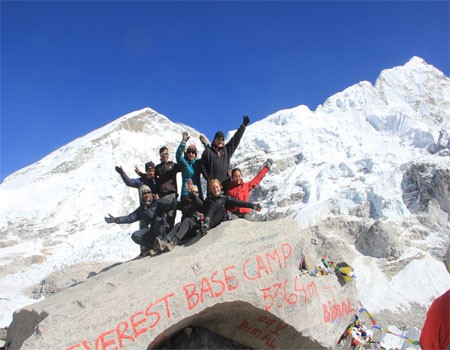
The trek from Lobuche to Gorakshep will be more leisurely than the previous day. However, the altitude will still make the walk strenuous. Today is also a special day because you will visit the base camp.
Start your day around 7 a.m. by hiking to the base camp. The trek will be long and may take around 8 hours. It takes 3 hours to reach Gorakshep, where you will spend the night. Here, you will have a quick lunch and leave your trekking gear.
After lunch, you will hike to base camp. Wear windproof, warm clothes and bring enough drinking water. The hike from Gorakshep to the base camp and back will take around five hours.
Day 9: Hike to Kala Patthar (5,550m) and Trek to Dzongla (4,830m)
Today, you will start early. You will climb Kala Patthar, which takes around 2 hours to reach the top. This hill offers stunning panoramic views of the Everest Himalayas all around you. The Kala Patthar Hike is not easy, though. It will be cold and windy, so wear warm and windproof clothing.
After returning from Kala Patthar toward Dzongla, you will continue along the same route until you reach Lobuche. After about half an hour from Lobuche, take a right and walk about two hours to reach Dzongla. You'll arrive by lunchtime and rest for the day before the next adventure.
Day 10: Trek from Dzongla to Gokyo (4,790m) via Cho La pass (5,360m)
Dzongla to Gokyo is another adventure day; you'll cross the next high pass (Cho La). You will start the day early, using a flashlight. The high passes can have strong winds if you start late, which's why you usually need to leave early.
A rocky, icy mountain brings you to the top of Cho La, then down to Thangnak. You will reach Thangnak for lunch. Some trekkers stay here if they get fatigued or have plenty of time. After lunch in Thangnak, you will walk another 2.5 to 3 hours, passing one of the giant glaciers in the Everest region. Once you reach Gokyo, you will see an amazing blue lake during autumn, but it freezes in spring.
Day 11: Hike to Gokyo Ri (5,360m) and overnight in Gokyo
Today is a short day, which might help you recover from the long trek over Cho La Pass. Here, you will start an early hike to Gokyo Ri. Hiking this hill will take you around 2 hours, which will be slightly more difficult climbing than Kala Patthar, but a lot less cold temperature.
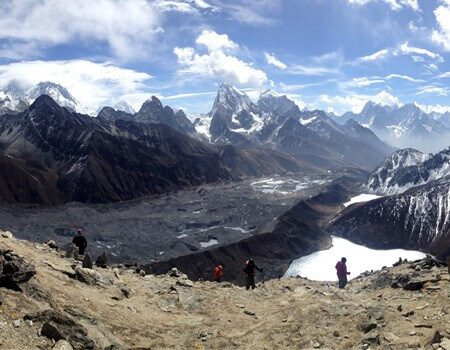
Gokyo Ri offers phenomenal mountain views, with beautiful lakes and glaciers. Many trekkers say the view from Gokyo Ri is far better than from Kala Patthar, and you can feel it when you reach the top. After descending from this hill, you'll have a full day to rest before another adventure day crossing Renjo La Pass.
Day 12: Trek from Gokyo to Lungden (4,380m) via Renjo La pass (5,360m)
Gokyo to Lungden is another adventure day, crossing Renjo La Pass. Renjo La Pass is one of the most effortless high passes among the three passes in the Everest region. It takes around 3 hours to reach the top from Gokyo, so you don't need to start as early as with the other two passes. But the trail after the pass is a long descent until Lungden, where you will spend the night.
It might take 7-8 hours to get to Lungden from Gokyo. From the top of Renjo La Pass, you'll get an unreal view of the mountains in the Everest region, including Mt. Makalu. You will reach Lungden for lunch and stay overnight.
Day 13: Trek from Lungden to Thame (3,800m)
Lungden to Thame is an easy day trek during the High Passes Trek. After 3-4 hours of descending, you reach Thame. Thame is a beautiful hidden valley where you can visit an old and historic Buddhist monastery. This more than 500-year-old monastery houses a reincarnated monk, a young man who lives with the other monks. You can see him and receive his blessing.
You'll also arrive in Thame for lunch, then spend time sightseeing and resting after the three big passes.
Day 14: Trek from Thame to Namche Bazaar (3,440m)
Thame to Namche Bazaar is also a short day trek. After breakfast, you descend towards the Bhotekoshi River and cross a temporary suspension bridge. After crossing the bridge, you will have a short climb, then an easy walk to Namche Bazaar.
It might take you 3-4 hours to reach Namche Bazaar from Thame. You can enjoy bakeries and bars, as well as watch mountain documentaries here. You can also celebrate completing three high-adventure passes in the evening.
Day 15: Trek from Namche Bazaar to Lukla (2,840m)
Today is your last day of the trek, and it will take about seven hours. However, walking around this area is easy because you are already at a lower elevation. You will descend, cross many suspension bridges over the Dudhkoshi River, and reach Phakding, where you will stop for lunch and spend your first night.
It takes another 3 hours, with a slight ascent, passing Ghat, Thadokoshi, and Chheplung villages after Phakding. After checking into the guest house in Lukla, you can celebrate your last night's mountain stay with the success of an adventure trek in the evening.
Day 16: Fly out to Kathmandu (1,350m)
On the first day of your trek, you will have an early morning flight from Lukla to Kathmandu. Confirm your schedule one day earlier because, if you disapprove, the airline office may get confused if you are sick at a higher altitude and arrange an evacuation flight.
After about half an hour of flying, you will land back in the city with a remarkable memory of the world's famous mountain experience and be ready to return home.
The itinerary in this post is suggested, but we can create a custom one based on your time frame and interests. Don't hesitate to contact us with any questions about this trip.
High Passes Trek Highlights
You will look for good things that attract you to your chosen destination. The highlights of this trek will make your trip a lifetime mountain adventure. Every single person might have different ways of enjoying and amazing other things.
Then, what makes your trip unforgettable? Let's check below, which should be on your highlighted checklist.
- Adventurous scenic mountain flight to Lukla
- Crossing three major challenging high passes of the Everest region
- Picturesque landscape and green hills
- Traditional Sherpa villages, local lifestyle, daily activities, and culture
- UNESCO World Heritage site Sagarmatha National Park
- Buddhist monasteries and other monuments
- Stunning viewpoints with eye-captivating mountain views
- Wildlife and vegetation
- Beautiful rivers and waterfalls
- Attractive valleys
- High Himalayan glacial lakes
- Crossing immense glaciers makes you feel like you are walking on the moon
- Learn about the Sherpa people, who are famous as mountain climbers
Try the Most Adventurous Everest High Passes

Kongma La Pass
The Everest High Pass is the most adventurous compared to Nepal's other adventures and High-Pass Treks. This trek makes your Himalayan journey more challenging because of the physical demands and altitude. Also, the tour had unclear paths when crossing the glacier and walking in the snow.
Not many people do this trek, and navigating a trail can be challenging. So, hiring a guidewho knows the trail is highly recommended. While the other High Pass Treks have only one pass, this trek requires crossing three. Moreover, crossing three major passes makes it a more adventurous tour than crossing a single Pass.
High Passes Everest Trek Equipment List

Main bag for trekking equipment
Good-quality trekking equipment is essential for any mountain trip. You need trekking gear for every easy and regular trek, and extra gear for the Everest High Passes. You know you should carry the necessary equipment, but what is it? Then, you can check the list below.
- Duffel bag or rucksack (60+ L)
- Daypack (for your valuable rain gear that you will use during the daytime)
- A few pairs of trekking trousers (half and full)
- Warm hat
- Sunglasses
- Sun hat
- Good quality trekking boots (which are the right size and comfortable to wear)
- Gaiters (use them while walking on snow and a muddy trail)
- Crampon
- A few pairs of trekking Shirts (half and full)
- Fleece jacket
- Down Jacket (Feather jacket)
- Rain cover
- Windproof trousers and jacket
- Thermal Layers
- Buff
- Inner Gloves
- Windproof Gloves
- Sports shoes and sandals
- A few pairs of trekking socks
- Sleeping bag and liner
- Earplugs
- Headtorch
- Trekking poles
- Extra camera batteries
- Enough Tissues and wipes
- Lip balm and moisturizer cream
- Sunblock
Besides these, you can pack snacks and everyday items, and check our equipment list here.
Accommodation During Everest High Passes

Lodge in the Everest region
Plenty of guesthouses and lodges line the trek. Ytrekan sleeps in lodges during the Everest Three Passes Trek. You will have a private room at each place you stay. It means you don't need to carry a tent on the trek.
Ytrekill has a food menu in the lodge where you stay. You can choose from the available menu items. You don't need to worry about local footwear on the trek. Btrekou can also try the local food items if you are interested.
You can buy bottled water at every lodge and along the way. But there are no lodges or tea shops between all three passes. You need to carry enough drinking water with you for the high passes. You can consult with your guide about this. You can also drink regular tap water, but don't forget to use purification tablets or sterilizers before drinking.
You might like this post on Everest High Passes Lodge Trek.
Best Time to Go
Autumn and spring are the best times to trek the Nepalese Himalayas. September to November and March to May are recommended for Trekking in Nepal and the Everest High Pass.
The first two weeks of September will still have some rainy days, so it might not be the best time. The end of the month can also bring raindrops. Spring trekking is warmer than autumn. However, the high passes may still have a lot of snow at the beginning of spring, so it's best to trek this trail from mid-March to mid-May.
The time frame mentioned above offers good visibility and temperatures. So, plan to trek to the Everest High Passes during these times.
Popular Everest Region Trekking Packages:
Other Adventure High Passes Trails in Nepal
By this time, you have found that the Everest High Pass is one of the most Adventurous Treks in Nepal. If the Three Passes Trek is too challenging, you may find other Adventure Trekking packages that suit you. These trekking routes have only one high pass and are rich in natural beauty. The adventure trekking routes are listed below.
Throng La High Pass (5'416 m)

Throng La Pass
The Annapurna Circuit Trek is in the Annapurna Region, west of Kathmandu. It is the most popular high Pass Trek among Nepal's other High Pass Treks. Hundreds of people trek this trek every day during the High Trekking Season. When there was no road, there were more trekkers than there are nowadays.
Tilicho is one of the world's highest Himalayan lakes; add a few more days to your trek to see it. Thorong La Pass is one of the world's most significant passes, with its altitude rising and falling in a single day.
Annapurna Circuit Trek is known for the Thorong La Pass and the Annapurna Trek. You will trek this trek with changing scenery each time. You can do the Annapurna Circuit as a full or half circuit. Starting from Bhulbhule and ending in Nayapul is a full circuit, and beginning from Bhulbhule and ending in Pokhara from Jomsom, taking a flight, is a half-Annapurna Circuit Trek.
Larke La Pass (5,160m)

Larke La Pass
The Manaslu Circuit Trek is an alternative to the Annapurna Circuit Trek. After the road construction on the Annapurna Circuit Trek, many trekkers were attracted to this Trekking Trail. Trekkers can experience a trek similar to the Annapurna Circuit Trek by walking for many days on the road.
The Manaslu Circuit Trek can be completed in 12 to 16 days, starting from Sotikhola and ending in Dharapani or Bhulbule. Contact us to set your time frame, and we will create an itinerary that fits you. Because the Manaslu Circuit Trek is in a unique area, you must obtain a special Trekking Permit from the Nepal immigration office. It's best to have Manaslu Conservation and Annapurna Conservation permits for this trek.
Manaslu Circuit is known as the Around Manaslu Trek and the Larke La Pass Trek. Unlike the Annapurna Circuit Trek, the Manaslu Circuit Trek has a much lower risk of altitude sickness because you start at a lower elevation and gain altitude gradually each day.
Sele La and Miring La Pass

Sele La Pass
Adventure Kanchenjunga Circuit Trek is the longest High-Pass Trek in Nepal. It is located in eastern Nepal, near India. This three-day trek takes almost 24 hours to complete. You can fly to Biratnagar, Tumlingtar, or Bhadrapur, then take a bus or jeep to Taplejung and start the trek from there.
You can do the Kanchenjunga Circuit Trek in either direction. Before passing Miring La and Sele La, you visit either the South Base Camp or the North Base Camp. This route has fewer trekkers than other adventure routes, but it requires an extended vacation and a long drive to the starting point.
People grow cardamom in this region, so you will see lots of cardamom along the way. Also, lower down in Jhapa and Ilam, you will see a tea garden while driving to Taplejung. If you don't have enough time for this Circuit Trek, you can do only the South Base Camp Trek or the North Base Camp Trek in Kanchenjunga.
Lauribina La Pass

Lauribina La Pass
Langtang Gosaikunda Trek is the nearest Adventure Trek from Kathmandu Valley. It is the most accessible trek-pass trek compared to the Ones mentioned above. At its altitude, it could be even more accessible than the Everest Base Camp trek. Trek. However, traversing Lauribina La can be a bit tiring for the trekkers.
This trekkiful trek takes a long drive on a hillside road to Syabrubesi by bus or private transport. You will follow the Langtang Valley to Kyanjin Gumba. After visiting Kyanjin Ri or Tserko-Ri for the views, you will return the same way for a couple of days, then take the left path to the Gosaikunda side.
You will love the several tranquil Himalayan Lakes near Gosaikunda. One of the best places to visit during the Gosaikunda trek is Istrekribinayak, where you can see stunning mountain views of Annapurna, Manaslu, Ganesh Himal, Langtang, and the Tibetan massifs.
Langtang Gosaikunda Lake Trek is also known as the Lauribina La Pass Trek or Langtang Gosaikunda Lake Trek. People also pronounce it Langtang Gosainkunda Trek. After crossing Lauribina La, you will trek for a few days before returning to Kathmandu.
Conclusion
Everest High Pass will be on your hit list if you are a real adventure lover. It is one of Nepal's most adventurous lodge treks, offering fantastic views and a once-in-a-lifetime adventure experience.
The key point of the High Pass Trek is crossing three major High Passes, which makes your hike more adventurous. Stunning views from the top of the passes, spectacular viewpoints, and walking through different valleys with stunning vistas will create an unforgettable mountain memory.
I hope the information above gives you what you need to know about the High Passes trek. Please get in touch with us if you need more information than what is provided in this post. We will always be happy to help.
If you are planning an Adventure trip, such as Everest High Pass or another mountain, this will help you decide where to go, what to do, and what to see. If your friends are planning an Everest adventure trip, you can recommend that they follow this post to share the information.